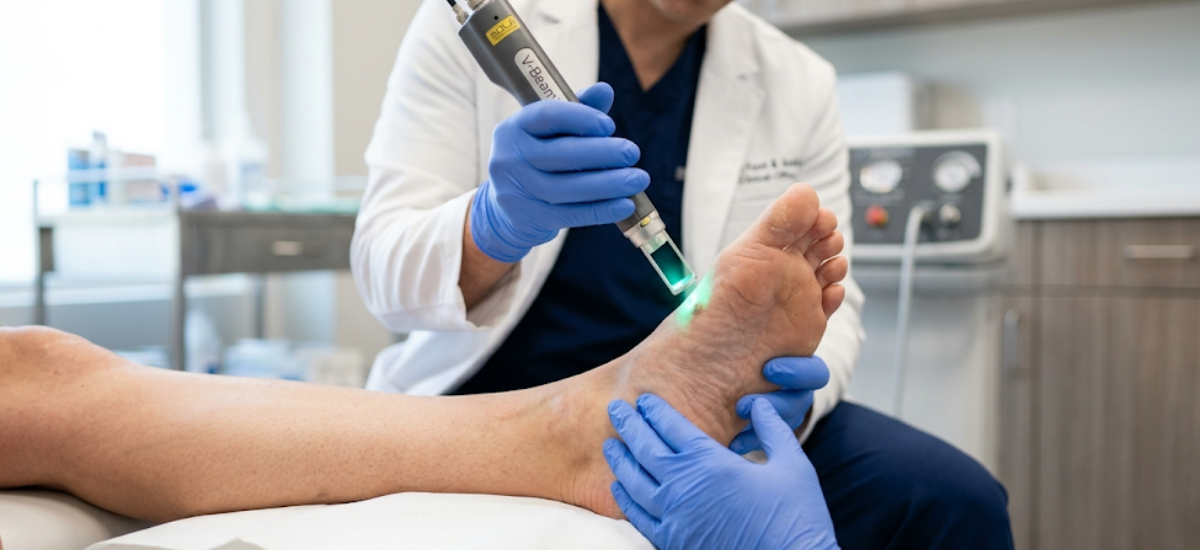
You have tried the over-the-counter patches. You have sat through multiple freezing treatments. And the plantar wart is still there, still painful, and in some cases still spreading. If that sounds familiar, pulse dye laser plantar wart treatment may be the solution you have been waiting for.
At Sole Foot and Ankle in Valparaiso, IN, Dr. Harpreet Minhas offers in-office pulse dye laser treatment for plantar warts, including stubborn and recurring cases that have resisted conventional therapy. This post breaks down exactly how it works, why it is so effective, and who it is right for.
What Is a Plantar Wart and Why Is It So Hard to Treat?
A plantar wart is a benign skin growth on the sole of the foot caused by the human papillomavirus (HPV). What makes plantar warts particularly difficult to eliminate is not their size. It is their location and structure.
Because the foot bears body weight with every step, plantar warts are forced inward rather than outward. This means the bulk of the wart sits beneath the skin surface, shielded from topical treatments that can only penetrate so far. The wart also builds its own network of tiny blood vessels, called capillaries, that keep it alive and supplied.
That blood supply is exactly what pulse dye laser treatment targets.
What Is Pulse Dye Laser Treatment?
Pulse dye laser (PDL) is a medical-grade laser that emits a concentrated beam of light at a specific wavelength, typically 585 to 595 nanometers. At this wavelength, the laser energy is selectively absorbed by the oxyhemoglobin in blood vessels.
In the context of plantar wart treatment, this selectivity is everything. The pulse dye laser targets and destroys the tiny capillaries feeding the wart, cutting off its blood supply without damaging the healthy skin around it. Without circulation, the wart tissue dies and the body clears it naturally.
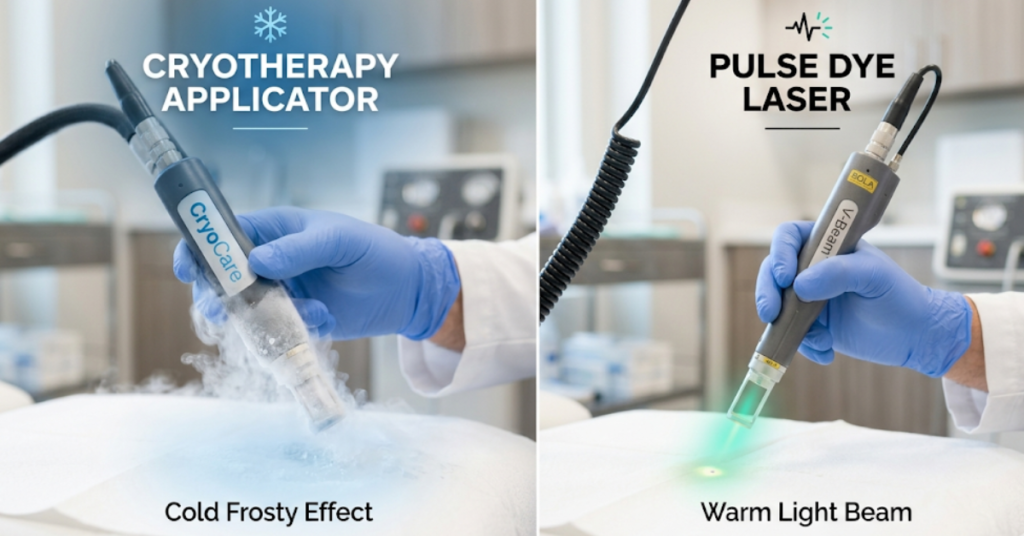
This mechanism is fundamentally different from treatments like cryotherapy, which freeze the surface tissue, or salicylic acid, which dissolves layers of skin. Pulse dye laser goes after the root of the problem at a vascular level.
How Effective Is Pulse Dye Laser for Plantar Warts?
The clinical evidence supporting pulse dye laser treatment for plantar warts is well established. Published research shows that simple warts respond to pulse dye laser in over 95% of patients, and recalcitrant warts show response rates ranging from 50% to 100% depending on the study, with recurrence rates documented as low as 0% to 15% at four-month follow-up.
One study using pulse dye laser for recalcitrant warts achieved an eradication rate of 92% after an average of just 2.1 treatment sessions, with most patients returning to normal activities immediately after each session.
For patients who have already tried and failed with cryotherapy or topical acid treatments, these numbers represent a meaningful step forward. The pulse dye laser is reaching the wart through a mechanism those treatments simply cannot replicate.
What to Expect During In-Office Pulse Dye Laser Treatment at Sole Foot and Ankle
One of the most common questions patients ask before pulse dye laser plantar wart treatment is what the procedure actually feels like. Here is a straightforward walkthrough of what to expect at Sole Foot and Ankle in Valparaiso, IN:
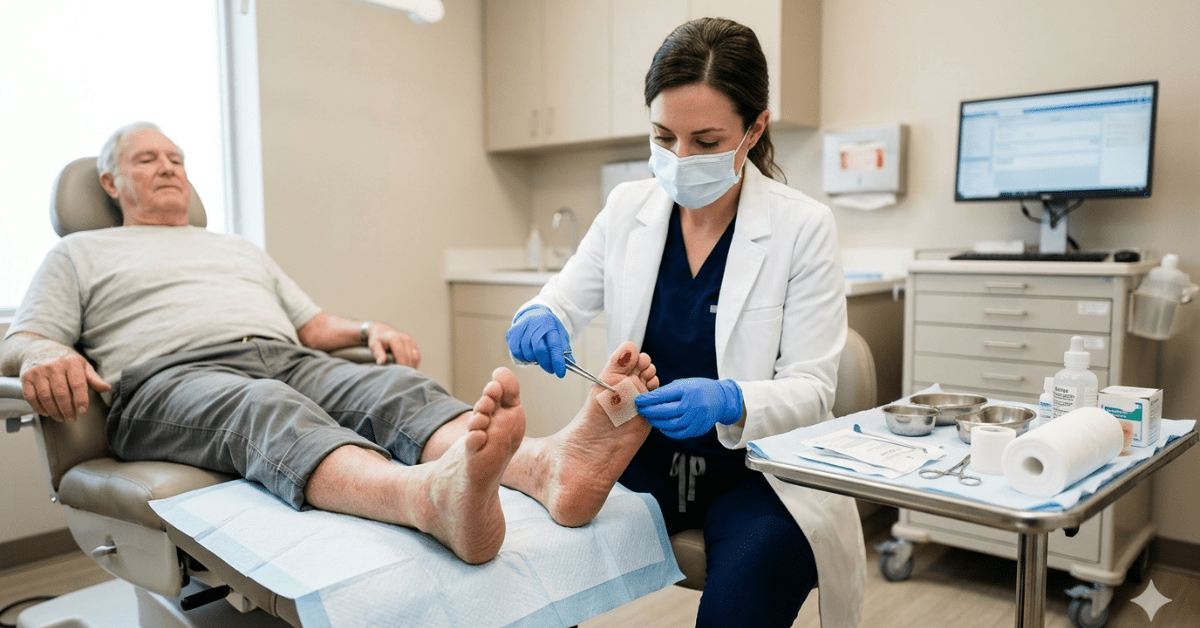
Before the procedure Dr. Minhas will examine the wart, confirm the diagnosis, and assess the size, depth, and duration of the lesion. For warts that have been present for a long time or are particularly thick, a brief debridement of the surface may be performed before the laser session to maximize penetration.
During the procedure A topical anesthetic or local anesthetic is applied to the treatment area to minimize discomfort. Most patients describe the sensation during the laser pulses as a mild snapping or stinging feeling. The procedure itself takes only a few minutes per wart.
After the procedure There is no open wound created by pulse dye laser treatment, which means no prolonged recovery period and no dressing changes. Some patients experience mild bruising or darkening of the treated area as the targeted blood vessels respond to the laser energy. This is a normal part of the process and typically resolves within one to two weeks.
Most patients are able to walk normally and return to their regular activities immediately after each session.
How Many Sessions Will I Need?
The number of pulse dye laser sessions required depends on several factors, including:
- The size and depth of the wart
- How long the wart has been present
- Whether it is a single wart or a cluster (mosaic warts)
- Whether prior treatments have created any scar tissue around the lesion
- The patient’s age and immune response
Most patients at Sole Foot and Ankle require between two and four sessions, spaced three to four weeks apart. Dr. Minhas assesses the wart’s response at each visit and adjusts the treatment plan accordingly. Warts that have been present for a shorter period of time and have not been subjected to multiple prior treatment attempts tend to respond in fewer sessions.
Who Is Pulse Dye Laser Plantar Wart Treatment Right For?
Pulse dye laser treatment is appropriate for a broad range of patients. It is particularly well suited for:
- Patients whose plantar warts have not responded to cryotherapy, salicylic acid, or other conventional treatments after multiple attempts
- Patients with mosaic warts or large wart clusters that are difficult to treat with topical methods
- Children and adolescents, for whom the minimal downtime and low risk of scarring are especially valuable
- Patients with sensitive skin who have experienced irritation or skin breakdown with other treatment approaches
- Diabetic patients who need a treatment option that minimizes the risk of tissue damage and secondary wound formation around the treatment site
- Anyone who wants a fast, in-office procedure with no recovery period and a high likelihood of lasting clearance
Pulse Dye Laser vs. Other Plantar Wart Treatments
Understanding how pulse dye laser compares to the alternatives helps explain why it is the preferred approach for stubborn and recurring warts at Sole Foot and Ankle.
Pulse Dye Laser vs. Cryotherapy Cryotherapy freezes the surface layers of the wart and the surrounding skin. It can be effective for small, superficial warts but has a higher recurrence rate for deep plantar lesions. It also causes more post-treatment pain and blistering than pulse dye laser. For patients who have already had multiple cryotherapy sessions without lasting clearance, pulse dye laser offers a different mechanism of action with a stronger evidence base for recalcitrant cases.
Pulse Dye Laser vs. Salicylic Acid Over-the-counter and prescription salicylic acid products work by chemically dissolving the layers of infected skin. They require weeks or months of consistent application and have a meaningful failure rate for established plantar warts. They also cannot reach the deep capillary network that sustains the wart. Pulse dye laser addresses the vascular root of the problem directly.
Pulse Dye Laser vs. Surgical Excision Surgical removal of a plantar wart involves cutting out the wart tissue under local anesthesia. While effective, it carries a higher risk of scarring, a longer recovery period, and a notable recurrence rate because the HPV virus may remain in the surrounding tissue. Pulse dye laser achieves comparable or superior clearance rates with a significantly more favorable recovery and safety profile.
Plantar Warts in Diabetic Patients: Why Pulse Dye Laser Is the Preferred Option
For patients with diabetes, peripheral neuropathy, or poor circulation, plantar wart treatment requires an especially careful approach. Aggressive treatments that cause skin breakdown or open wounds can create significant complications in patients with impaired healing and reduced immune function.
Pulse dye laser is one of the most appropriate treatment modalities for diabetic patients with plantar warts for several reasons. It does not create an open wound. It produces minimal surrounding tissue damage. It has a favorable safety profile for patients with sensitive or fragile skin. And it achieves clearance in fewer sessions than many conventional alternatives, reducing the cumulative risk of repeat treatment exposures.
At Sole Foot and Ankle, diabetic patients with plantar warts receive treatment that is integrated with our broader expertise in diabetic foot care and wound prevention in Valparaiso, IN.
Frequently Asked Questions
Is pulse dye laser plantar wart treatment painful? The procedure is well tolerated by most patients. A topical or local anesthetic is used before treatment, and most patients describe the laser pulses as a mild snapping sensation. Post-treatment soreness is typically minimal and manageable with over-the-counter pain relief if needed.
How soon will I see results? The treated wart tissue begins to break down in the weeks following each session as the capillaries destroyed by the laser are reabsorbed by the body. Most patients notice visible improvement after the first or second session, with full clearance typically achieved within the complete treatment course.
Can plantar warts come back after pulse dye laser treatment? Recurrence is possible with any wart treatment because the HPV virus can remain dormant in the surrounding skin. However, pulse dye laser has among the lowest documented recurrence rates of any non-surgical plantar wart treatment. Preventing re-exposure through basic foot hygiene practices, including wearing footwear in communal areas and keeping feet dry, reduces the risk of new wart formation after successful treatment.
Is pulse dye laser safe for children? Yes. Pulse dye laser is one of the most suitable treatment options for children and adolescents with plantar warts. The minimal downtime, low risk of scarring, and high effectiveness make it well tolerated and appropriate for younger patients.
Can I walk normally after the procedure? Yes. Because pulse dye laser does not create an open wound, most patients walk normally immediately after each treatment session and return to their regular activities the same day.
Stop Living With a Wart That Won’t Go Away
Plantar warts are not something you should have to manage indefinitely. If over-the-counter treatments have let you down and repeated freezing sessions have not delivered lasting clearance, pulse dye laser plantar wart treatment at Sole Foot and Ankle in Valparaiso, IN offers a clinically proven, in-office solution that targets the root of the problem directly.
Dr. Harpreet Minhas provides pulse dye laser wart treatment for patients of all ages throughout Valparaiso, Portage, Chesterton, Merrillville, and all of Northwest Indiana. Call us today or book online to schedule your evaluation.