

Fish skin grafts are changing the future of wound care. A diabetic foot ulcer can feel like an endless cycle of dressing changes, discomfort, and worry about infection. Many patients fear that a wound that will not close could eventually lead to serious complications.
These advanced grafts, derived from specially processed fish skin, closely mimic the structure of human skin. They create a natural scaffold that encourages the body to regenerate healthy tissue.
In modern diabetic foot ulcer treatment, technologies like Kerecis fish skin grafts have become a major advancement in advanced wound care, helping stubborn wounds heal faster while reducing complications.
What Are Fish Skin Grafts?
Fish skin grafts are biologic wound treatments created from North Atlantic cod skin. The material is processed so it is safe for medical use while preserving its natural structural properties.
Unlike synthetic wound coverings, fish skin contains naturally occurring omega-3 fatty acids and a collagen structure that closely resembles human skin.
Why This Matters
Because of this similarity, fish skin grafts can:
- Support natural tissue growth
- Encourage faster wound closure
- Reduce inflammation
- Lower infection risk
- Improve healing outcomes
The result is a biologic wound treatment that works with the body instead of simply covering the wound.
How Fish Skin Grafts Work in Advanced Wound Care
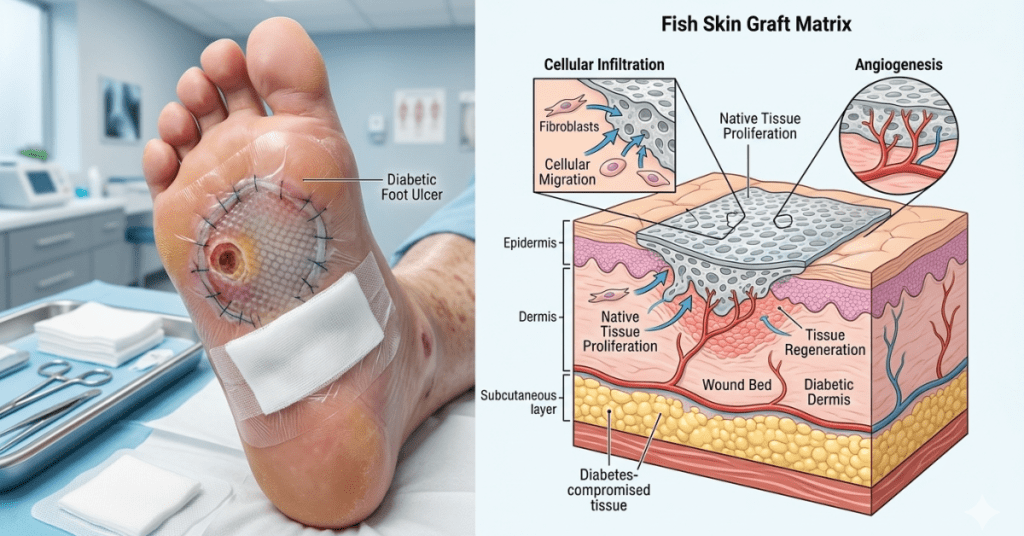
When placed over a wound, fish skin grafts act as a biological scaffold.
This scaffold allows the patient’s own cells to migrate into the graft and regenerate new tissue. Over time, the graft becomes integrated into the healing skin.
The Healing Process
- The wound is carefully cleaned and prepared
- The fish skin graft is applied to the ulcer
- The graft supports cellular growth
- New tissue forms gradually
- The wound closes as healthy skin regenerates
This approach represents a shift from traditional wound management to regenerative medicine.
7 Reasons to Consider Fish Skin for Ulcer Treatment
1. Faster Healing for Chronic Wounds
Many diabetic ulcers stall in the healing process. Fish skin grafts help restart tissue regeneration by providing a natural biological framework.
2. Better Skin Compatibility
The architecture of fish skin closely resembles human skin. This makes it easier for the body to accept the graft and build new tissue.
3. Lower Infection Risk
Omega-3 fatty acids found in fish skin help reduce inflammation and support a healthier wound environment.
4. Reduced Need for Amputation
Early treatment with advanced graft technology can dramatically lower the risk of severe complications associated with diabetic foot ulcers.
5. Works When Other Treatments Fail
Traditional wound dressings sometimes fail to stimulate healing. Fish skin grafts provide an active regenerative platform rather than passive coverage.
6. Less Scar Tissue
Because the graft integrates into the skin during healing, the resulting tissue often looks and functions more naturally.
A Modern Approach to Advanced Wound Care
When combined with modern podiatric technology, fish skin grafts become even more effective.
For example:
- AI gait analysis can identify pressure points that slow healing
- 3D-printed orthotics redistribute weight away from ulcers
- Regenerative biologics can support tissue repair
Together, these tools provide a comprehensive wound treatment strategy.
Fish Skin Grafts vs Traditional Ulcer Treatments
Traditional wound care methods include:
- Standard dressings
- Skin substitutes
- Synthetic grafts
- Debridement procedures
While these treatments can help, they do not always stimulate true tissue regeneration.
Fish skin grafts stand out because they replicate natural skin structure, allowing the body to rebuild healthy tissue rather than simply protecting the wound.
Is It a Diabetic Foot Ulcer or Something Else?
Not every foot wound is the same. A specialist must determine the underlying cause.
Common Differential Diagnoses
Some wounds that resemble diabetic ulcers may actually be:
- Pressure sores
- Vascular ulcers
- Traumatic wounds
- Infection-related skin breakdown
Proper diagnosis is essential because each condition requires a different treatment approach.
Who Is a Candidate for Fish Skin Grafts?
You may benefit from this treatment if you have:
- A diabetic foot ulcer that is slow to heal
- A chronic wound lasting more than four weeks
- Poor circulation affecting wound healing
- A history of recurrent ulcers
A podiatric evaluation helps determine whether fish skin graft therapy is appropriate.
Expert Ulcer Care at Sole Foot & Ankle
At Sole Foot & Ankle in Valparaiso, Indiana, our team provides advanced treatment options for chronic wounds and diabetic foot complications.
We combine:
- Advanced wound care technology
- Biologic graft therapies
- Custom orthotic solutions
- Comprehensive diabetic foot management
Our goal is simple: help patients heal faster and protect long-term foot health.
Schedule a Wound Care Consultation
If you are dealing with a diabetic foot ulcer that refuses to heal, early treatment can make a life-changing difference.
The specialists at Sole Foot & Ankle in Valparaiso, IN provide expert evaluation and advanced wound care treatments including fish skin graft therapy.
Schedule an appointment today to learn whether this breakthrough treatment could help your wound heal faster and more safely.
Frequently Asked Questions
Can fish skin be used for skin grafts?
Yes. Medical-grade fish skin can be processed and used as a biologic graft to help wounds heal. These grafts act as a natural scaffold that supports tissue regeneration. They are commonly used in advanced wound care for diabetic foot ulcers, burns, and other chronic wounds.
Is fish skin graft better than human skin grafts?
Fish skin grafts are not necessarily “better,” but they offer several advantages in certain cases. They contain a natural collagen structure and omega-3 fatty acids that support healing and reduce inflammation. They are also readily available and do not require harvesting skin from another part of the patient’s body, which avoids additional surgical wounds.
What is the name of the fish skin graft used in medicine?
One of the most widely used fish skin graft products is Kerecis®, a medical-grade graft derived from North Atlantic cod skin. It is commonly used for diabetic wound care and other chronic ulcers.
What fish are used for skin grafts?
Most modern medical fish skin grafts are made from Atlantic cod. The skin of this fish has a collagen structure that closely resembles human skin, making it effective for wound healing applications.
Are tilapia skin grafts expensive?
Tilapia skin grafts have been studied and used in some countries because they are relatively low-cost compared to other graft materials. However, in many clinical settings, especially in the United States, cod-derived grafts like Kerecis are more commonly used because they are FDA cleared and widely available for advanced wound care.

