
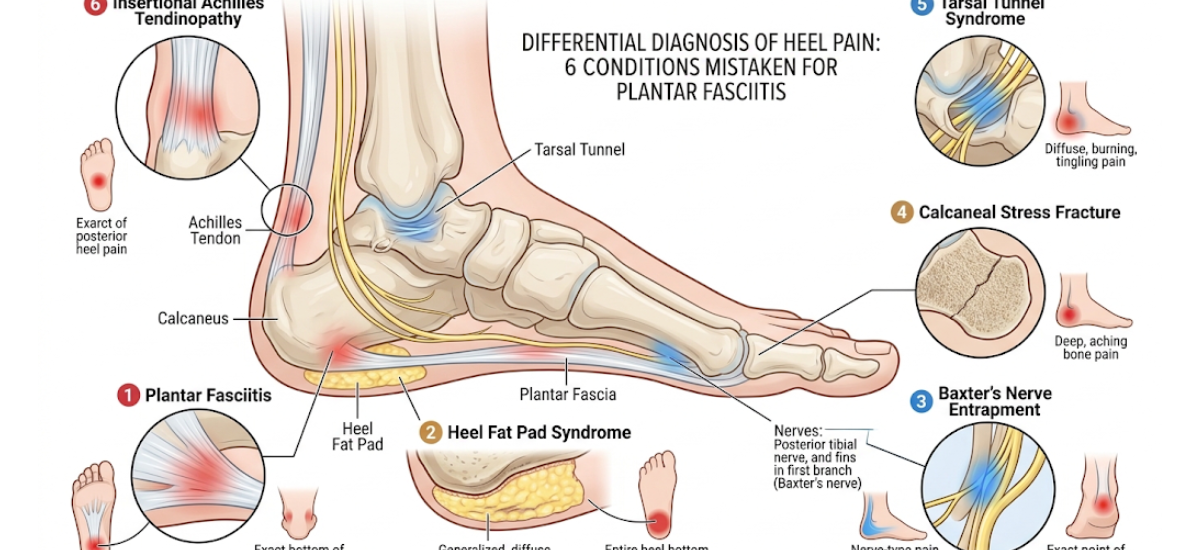
If you are trying to pin down the causes of heel pain you are experiencing, you are not alone. Heel pain is one of the most common reasons people walk into our office, and almost every one of them says the same thing: “I think I have plantar fasciitis.” Sometimes they’re right. Often they’re not. Plantar fasciitis gets blamed for nearly every ache in the heel, but at least six other conditions can cause heel pain that feels remarkably similar, and each one needs a different treatment to actually get better.
If you’ve been icing, stretching, and resting a “plantar fasciitis” that refuses to improve, it may not be plantar fasciitis at all. Here are the six most common heel pain causes, how to tell them apart, and why getting the right diagnosis changes everything.
Condition 1: Plantar Fasciitis
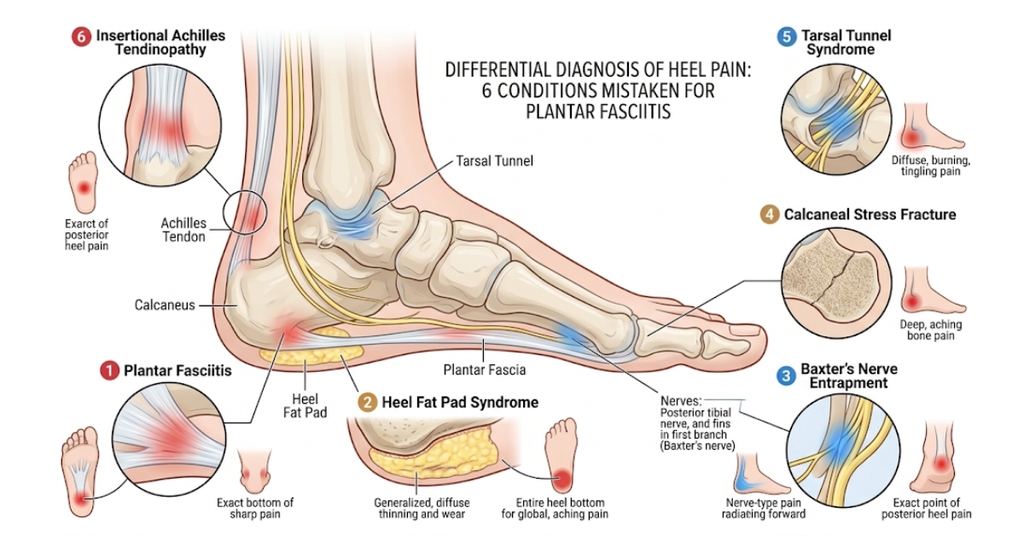
Plantar fasciitis remains the single most common cause of heel pain, and for good reason: it accounts for a large share of the heel pain cases seen in podiatry offices every year. It’s caused by inflammation and micro-tearing of the plantar fascia, the thick band of tissue that runs along the bottom of the foot from the heel to the toes
The hallmark sign is pain concentrated at the bottom of the heel, worst with the very first steps in the morning or after sitting for a while, that gradually eases as you move but returns after long periods on your feet. Pressing directly on the inside of the heel bone typically reproduces the pain.
Plantar fasciitis usually responds well to stretching, supportive footwear, custom orthotics, and activity modification. If you want a deeper look at causes, symptoms, and treatment, we’ve covered it in detail in our guide to plantar fasciitis causes, symptoms, and treatment.
Condition 2: Heel Fat Pad Syndrome
Underneath your heel bone sits a specialized cushion of fat that absorbs shock with every step. As this fat pad thins with age, repetitive impact, or after cortisone injections, that natural shock absorption breaks down, a condition called heel fat pad syndrome.
Unlike plantar fasciitis, fat pad syndrome causes pain directly in the center of the heel, not along the arch side, and it tends to worsen the longer you’re on hard surfaces rather than easing once you’re warmed up. Walking barefoot on tile or concrete is often the most painful activity. Treatment focuses on cushioning (padded heel cups, shock-absorbing insoles, and supportive shoes) rather than the stretching protocols used for plantar fasciitis.
Condition 3: Baxter’s Nerve Entrapment
Baxter’s nerve entrapment is one of the most frequently missed causes of chronic heel pain. It occurs when a small nerve branch (the first branch of the lateral plantar nerve) becomes compressed as it passes between muscles near the inside of the heel.
Because the entrapment sits close to the plantar fascia, the pain location can overlap with plantar fasciitis, which is exactly why it’s so often misdiagnosed. The distinguishing clues are a burning, tingling, or electric quality to the pain rather than a dull ache, tenderness slightly more toward the inner ankle than the bottom of the heel, and pain that doesn’t respond to standard plantar fasciitis stretching and orthotics after several weeks. Treatment may involve nerve-focused physical therapy, targeted injections, or, in persistent cases, surgical release.
Condition 4: Calcaneal Stress Fracture
A calcaneal stress fracture is a small hairline crack in the heel bone itself, usually brought on by a sudden increase in running mileage, a new high-impact activity, or repetitive stress on bone that’s already weakened by low bone density.
The telltale difference from plantar fasciitis is that a stress fracture hurts with every single step, including gentle ones, and squeezing the heel bone from both sides (rather than pressing on the bottom) reproduces the pain. It doesn’t ease up with movement the way plantar fasciitis often does. Because a stress fracture won’t heal properly if you keep walking on it, an accurate diagnosis matters immediately. This is one of the few causes of heel pain where imaging is usually needed and where continuing to “push through it” can make things significantly worse.
Condition 5: Tarsal Tunnel Syndrome
Tarsal tunnel syndrome is the foot’s version of carpal tunnel syndrome. The posterior tibial nerve becomes compressed as it travels through a narrow tunnel near the inside of the ankle, and the resulting pain can radiate into the heel and along the bottom of the foot.
What sets tarsal tunnel syndrome apart is the character and pattern of the symptoms: burning, tingling, numbness, or a “pins and needles” sensation, often worse at night or after prolonged standing, and sometimes accompanied by pain that travels up toward the ankle rather than staying confined to the heel. Patients with diabetes or swelling-related conditions are at higher risk. Because the underlying problem is nerve compression, treatment is very different from plantar fasciitis and may include bracing, anti-inflammatory therapy, or nerve decompression when conservative care doesn’t help. If numbness or tingling is part of your heel pain, our guide on diabetic heel pain causes and care covers related warning signs worth knowing.
Condition 6: Insertional Achilles Tendinopathy and Haglund’s Deformity
Not all heel pain is on the bottom of the foot. Insertional Achilles tendinopathy causes pain at the back of the heel, right where the Achilles tendon attaches to the heel bone, and is often accompanied by a bony enlargement known as Haglund’s deformity, sometimes nicknamed a “pump bump” because it’s frequently irritated by rigid-backed shoes.
The pain here is at the back of the heel rather than underneath it, is aggravated by shoes that rub against the heel counter, and often comes with visible swelling or a firm bump. Treatment typically involves shoe modification, heel lifts, eccentric strengthening exercises, and in more advanced cases, procedures to address the bone enlargement directly.
A Quick Word on Referred Heel Pain
Occasionally, heel pain isn’t coming from the heel at all. Nerve irritation higher up in the leg or lower back, circulation problems, or inflammatory arthritis conditions can all refer pain down into the heel. This is uncommon compared to the six causes above, but it’s part of why a pattern of heel pain that doesn’t fit neatly into any of the usual categories deserves an in-person evaluation rather than guesswork.
Heel Pain Causes: Why the Right Diagnosis Changes Everything
Here’s the problem with assuming every heel pain is plantar fasciitis: the standard plantar fasciitis playbook (calf stretching, night splints, arch support) can be exactly the wrong approach for a nerve entrapment, a stress fracture, or fat pad syndrome. Stretching an already-irritated nerve can make Baxter’s nerve entrapment worse. Continuing high-impact activity on a stress fracture can turn a simple healing process into a much longer one. And generic arch supports do very little for pain that’s actually coming from the back of the heel.
This is why heel pain that hasn’t improved after a few weeks of home care, or that has an unusual quality (burning, numbness, pain with every single step, or pain at the back rather than the bottom of the heel) is worth having examined rather than continuing to self-treat for plantar fasciitis.
Getting an Accurate Diagnosis for the Causes of Heel Pain
At Sole Foot and Ankle, Dr. Harpreet Minhas evaluates heel pain with a hands-on exam, a review of your activity and symptom pattern, and imaging when it’s needed to rule out a stress fracture or confirm nerve involvement. That combination is what separates an accurate diagnosis from a guess, and it’s the difference between treatment that works and months of managing the wrong condition.
If your heel pain hasn’t responded the way plantar fasciitis usually does, or something about it just feels different, we encourage you to schedule an evaluation so we can find out exactly what’s causing it.
Frequently Asked Questions About the Causes of Heel Pain
How do I know if my heel pain is plantar fasciitis or something else?
Plantar fasciitis classically causes sharp pain at the bottom of the heel that’s worst with your first steps in the morning and eases as you move. Burning, tingling, numbness, pain with every step regardless of activity, or pain at the back of the heel instead of the bottom are all signs it may be a different condition, and an exam can confirm which one.
Can heel pain be a stress fracture instead of plantar fasciitis?
Yes. A calcaneal stress fracture hurts with every step rather than easing with movement, and squeezing the heel bone from the sides reproduces the pain. This typically requires imaging to diagnose and rest to heal properly, so it’s important not to assume it’s plantar fasciitis and keep pushing through it.
Why isn’t my “plantar fasciitis” getting better with stretching and orthotics?
If standard plantar fasciitis treatment hasn’t helped after several weeks, the underlying cause may be something else entirely, such as a nerve entrapment, fat pad syndrome, or tarsal tunnel syndrome, each of which needs a different treatment approach to improve.
What does nerve-related heel pain feel like compared to plantar fasciitis?
Nerve-related heel pain, such as Baxter’s nerve entrapment or tarsal tunnel syndrome, typically feels like burning, tingling, or electric sensations rather than the dull, sharp ache of plantar fasciitis, and it may radiate toward the ankle or worsen at night.
When should I see a podiatrist about heel pain?
If heel pain hasn’t improved after two to three weeks of rest, ice, and supportive shoes, if it hurts with every step, or if you notice numbness, tingling, or swelling, it’s time to have it evaluated rather than continuing to guess at the cause.
Understanding the real causes of heel pain is the first step toward lasting relief. Ready to find out what’s really causing your heel pain? Schedule an evaluation with Sole Foot and Ankle in Valparaiso, IN, and get a diagnosis you can actually treat.