


If you have diabetes, annual diabetic foot exams are one of the most important medical appointments you can keep — yet they are among the most frequently skipped. Many patients assume that if their feet do not hurt, nothing is wrong. That assumption costs limbs every year.
That is the hidden danger of diabetic peripheral neuropathy. It does not announce itself with fanfare. It removes sensation gradually, year by year, until the cut on your heel, the blister from a new shoe, or the pressure sore developing beneath a bony prominence goes completely unnoticed. By the time it becomes visible, the wound may already be infected. By the time it becomes painful, the infection may already be deep.
At Sole Foot and Ankle in Valparaiso, IN, Dr. Harpreet Minhas and our team conduct comprehensive diabetic foot exams designed to catch the problems that have no symptoms yet, and act on them before they become emergencies. This post explains exactly why these exams matter, what they involve, and what happens when patients skip them.
Why Diabetic Foot Exams Are a Medical Priority, Not a Routine Checkup
Diabetic foot exams are not optional for patients living with Type 1 or Type 2 diabetes. The clinical evidence is clear and the stakes are high.
The lifetime risk of developing a diabetic foot ulcer ranges from 19% to 34%, with North America recording the highest regional prevalence rate at 13%. These are not rare edge cases. They represent a very real possibility for every patient with diabetes who does not receive proactive foot monitoring.
The consequences of an untreated ulcer are severe. Following incident ulceration, recurrence rates reach 65% within three to five years, lifetime lower extremity amputation incidence is 20%, and five-year mortality sits between 50% and 70%.
Approximately 60% of patients undergoing lower extremity amputation have diabetic foot ulcers as the underlying cause, and following a lower extremity amputation, the five-year mortality rate jumps to 60%.
These numbers exist not to frighten, but to frame the stakes clearly. The vast majority of diabetic foot amputations are preventable. Annual diabetic foot exams are one of the most important tools in that prevention effort.
What the ADA Says About Annual Diabetic Foot Exams in 2026
The clinical guidance on diabetic foot exams is unambiguous. The American Diabetes Association’s 2026 Standards of Care in Diabetes state that all people with diabetes should undergo a comprehensive foot examination at least annually, or more frequently for those in higher risk categories.
Higher risk patients include those with existing peripheral neuropathy, peripheral arterial disease, a history of prior foot ulcers or amputation, significant foot deformities, or poor glycemic control. For these patients, quarterly or even monthly diabetic foot exams may be appropriate.
The ADA also recommends that foot care education be provided to all newly diagnosed people with diabetes as part of an annual comprehensive examination, and reinforced at every visit for high-risk patients, noting that knowledge gained through education is quickly forgotten without regular reinforcement.
At Sole Foot and Ankle, diabetic foot care education is a structured part of every exam visit, not an afterthought.
How Diabetes Damages the Feet — Why Diabetic Foot Exams Catch What You Cannot Feel
Understanding why diabetic foot exams are so critical requires understanding what diabetes does to the feet over time. Three interconnected processes create the unique vulnerability of the diabetic foot.
Peripheral Neuropathy — The Silent Risk That Makes Diabetic Foot Exams Essential
Chronic exposure to elevated blood glucose damages the peripheral nerve fibers serving the feet and lower legs. Sensory neuropathy reduces or eliminates the ability to feel pain, pressure, temperature, and tissue injury. Motor neuropathy weakens the intrinsic foot muscles, causing progressive toe deformities that create high-pressure bony prominences. Autonomic neuropathy dries out the skin by disrupting sweat regulation, creating fissures and cracks that serve as entry points for bacteria and fungi.
Peripheral Arterial Disease
Diabetes accelerates the buildup of arterial plaque throughout the body, including the vessels supplying the feet. Reduced blood flow means less oxygen, fewer immune cells, and a dramatically impaired healing capacity. A wound that would resolve quickly in a healthy patient can become a chronic, non-healing ulcer in a patient with significant peripheral arterial disease.
Impaired Immune Response
Chronically elevated blood glucose compromises white blood cell function, making diabetic patients significantly more susceptible to infection and less able to contain it once established. Infections that would be minor in a non-diabetic patient can progress to deep tissue infection, osteomyelitis, and sepsis with alarming speed.
Together, these three processes create a foot that cannot feel injury, cannot heal efficiently, and cannot fight infection effectively. That combination is precisely why regular diabetic foot exams at Sole Foot and Ankle in Valparaiso, IN are so critical to long-term limb preservation.
What Happens During Diabetic Foot Exams at Sole Foot and Ankle
A diabetic foot exam at Sole Foot and Ankle is not a cursory glance at your feet. It is a structured, comprehensive clinical evaluation that assesses every component of foot health relevant to diabetes management. Here is what Dr. Minhas evaluates at each visit:
Sensory Testing During Your Diabetic Foot Exam
Using a 10-gram Semmes-Weinstein monofilament, Dr. Minhas tests protective sensation at multiple points on the foot. Loss of protective sensation at even one site is a significant finding that changes the management plan. Vibratory sensation is assessed using a 128 Hz tuning fork, and temperature discrimination testing identifies early autonomic nerve involvement.
Vascular Assessment
Pedal pulses are palpated at the dorsalis pedis and posterior tibial arteries. When pulses are diminished or absent, non-invasive vascular testing including ankle-brachial index measurement is performed, and referral to vascular surgery is coordinated when significant peripheral arterial disease is identified.
Skin and Nail Inspection
Every square centimeter of the foot is visually inspected for callus formation, skin fissures, fungal infection, ingrown toenails, blistering, pressure sores, maceration between the toes, and any area of skin breakdown or discoloration. Calluses over bony prominences are a particular focus, as they are a primary precursor to ulcer formation in diabetic patients.
Structural and Biomechanical Assessment
Hammertoes, bunions, claw toes, flat feet, and other structural abnormalities are assessed and documented. These deformities create bony prominences that, in the presence of neuropathy and poor circulation, become sites of predictable ulceration. Managing them proactively is a central part of diabetic foot care at Sole Foot and Ankle.
Footwear Evaluation
The shoes and socks a patient wears to the appointment are examined for fit, wear patterns, internal seam placement, and overall suitability for a neuropathic foot. Ill-fitting footwear is one of the most common and most preventable causes of diabetic foot injury.
Risk Stratification After Each Diabetic Foot Exam
After the full examination, Dr. Minhas assigns a risk category based on the findings and determines the appropriate follow-up frequency. Low-risk patients are seen annually. Moderate and high-risk patients are scheduled more frequently, because the window between a preventable complication and a limb-threatening one can be very short.
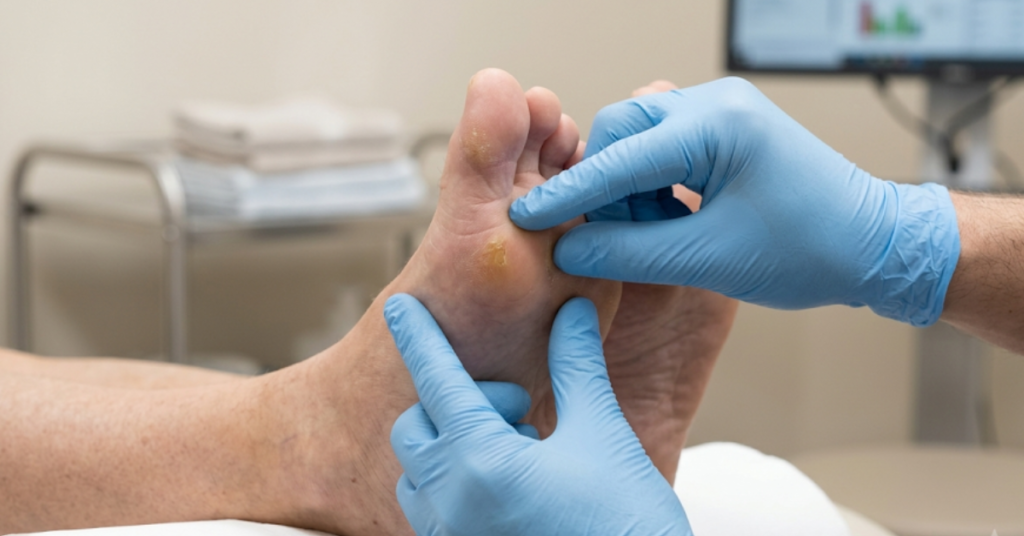
What Diabetic Foot Exams Detect That Patients Cannot See Themselves
One of the most important functions of professional diabetic foot exams is detecting what patients cannot detect through daily self-inspection at home. Several findings are only identifiable by a trained podiatrist with the right diagnostic tools.
- Pre-ulcerative callus with a hemorrhagic center beneath the skin surface, a common precursor to ulcer formation that appears as an ordinary callus to the untrained eye
- Early Charcot changes, including subtle warmth, swelling, or erythema in a neuropathic foot that may represent the earliest stage of Charcot neuroarthropathy, a devastating bone destruction condition that must be identified and offloaded before structural collapse occurs
- Diminished or absent pedal pulses suggesting subclinical peripheral arterial disease that has not yet caused symptoms
- Loss of protective sensation in patients who feel entirely normal and have no idea their feet can no longer reliably detect pain
- Subungual hematoma or nail bed infection beneath a thickened toenail that is invisible externally
- Early interdigital maceration or fungal infection between toes that creates a portal for bacterial entry
How Diabetic Foot Exams Lead to Custom Orthotics and Ulcer Prevention
A comprehensive diabetic foot exam at Sole Foot and Ankle is not just a diagnostic exercise. It is also the starting point for interventions that actively reduce risk. One of the most evidence-supported preventive tools for diabetic patients is custom orthotics specifically engineered for the neuropathic foot.
Custom diabetic orthotics use total contact design principles to redistribute plantar pressure away from high-risk bony prominences, accommodate existing deformities, and reduce the focal loading that drives ulcer formation. Combined with properly fitted therapeutic footwear, they represent one of the most effective strategies available for preventing first and recurrent diabetic foot ulcers.
Dr. Minhas fabricates custom diabetic orthotics following a thorough biomechanical assessment at each diabetic foot exam visit, adjusting the prescription as the patient’s foot structure, deformity status, and neuropathy severity evolve over time.
Daily Foot Care Habits to Practice Between Diabetic Foot Exams
Your annual diabetic foot exam at Sole Foot and Ankle is the professional anchor of your foot health management. What happens on the other 364 days of the year matters just as much. Here are the daily habits Dr. Minhas teaches every diabetic patient during their exam visit:
- Inspect both feet every single day, including the soles and between the toes, using a mirror or asking a caregiver for help if bending is difficult
- Wash feet daily with lukewarm water and dry thoroughly, paying particular attention between the toes
- Apply moisturizer to the soles and heels to prevent cracking, but never between the toes where trapped moisture promotes fungal growth
- Never walk barefoot, including inside the house, as even a minor floor hazard can cause an undetected injury
- Wear properly fitted, seamless diabetic socks and change them daily
- Inspect the inside of shoes for foreign objects, rough seams, or debris before putting them on
- Trim toenails straight across and not too short; contact Sole Foot and Ankle for professional nail care if trimming is difficult or if nails are thickened
- Contact Sole Foot and Ankle immediately if you notice any new wound, blister, redness, swelling, discoloration, or skin change on either foot
Signs You Should Not Wait for Your Next Diabetic Foot Exam
Certain situations require contacting Sole Foot and Ankle without waiting for your next scheduled diabetic foot exam. Do not adopt a wait-and-see approach with any of the following:
- Any open wound, sore, or blister on the foot, regardless of how small it appears
- Redness, warmth, or swelling in any area of the foot or ankle
- Dark or black tissue anywhere on the foot
- A toenail that is ingrown, infected, or significantly thickened
- A foot or ankle that suddenly becomes warm, swollen, and red without an obvious traumatic cause, a potential sign of Charcot foot requiring immediate offloading
- New or worsening numbness, tingling, or burning in the feet
- Any change in foot shape or the appearance of a new bony prominence
In diabetic foot care, hours genuinely matter. The difference between a minor wound and a limb-threatening infection can be measured in days, not weeks.
Frequently Asked Questions About Diabetic Foot Exams
How often should I have diabetic foot exams if I have neuropathy?
If you have documented peripheral neuropathy, a history of foot ulcers, significant foot deformities, or peripheral arterial disease, annual diabetic foot exams are not sufficient. Dr. Minhas recommends visits every one to three months for moderate-risk patients and monthly visits for high-risk patients at Sole Foot and Ankle in Valparaiso, IN. The appropriate frequency is determined at your initial comprehensive exam and adjusted as your condition evolves.
Are diabetic foot exams covered by Medicare or insurance?
Yes. Annual comprehensive diabetic foot exams are covered by Medicare Part B for patients with diabetes, and most major insurance plans provide coverage when the exam is medically indicated. Our team at Sole Foot and Ankle will verify your specific benefits before your appointment and handle any documentation required for coverage.
What is the difference between a diabetic foot exam and a regular podiatry visit?
A diabetic foot exam is a structured, protocol-driven evaluation that specifically assesses every component of foot health relevant to diabetes management, including protective sensation testing, vascular assessment, skin and nail inspection, structural evaluation, and risk stratification. A general podiatry visit may address a specific concern without this comprehensive framework. At Sole Foot and Ankle, all diabetic patients receive the full structured exam at every visit, regardless of the presenting concern.
My feet do not hurt. Do I still need diabetic foot exams?
Yes, and this is arguably the most important situation of all. The absence of foot pain in a diabetic patient is not reassurance. It is a risk factor. Sensory neuropathy removes pain before it removes the danger. Many patients with significant neuropathy feel entirely normal until a serious wound is already established. Annual diabetic foot exams at Sole Foot and Ankle are specifically designed to catch what you cannot feel.
Can diabetic foot amputations be prevented with regular diabetic foot exams?
In the vast majority of cases, yes. The clinical evidence is clear that proactive diabetic foot exams, patient education, appropriate footwear, custom orthotics, and early intervention when problems are identified dramatically reduce the risk of amputation. At Sole Foot and Ankle, limb preservation is not just a goal. It is the primary mission of our diabetic foot care program.
Schedule Your Diabetic Foot Exam at Sole Foot and Ankle in Valparaiso, IN
If you have diabetes and have not had a comprehensive diabetic foot exam in the past year, now is the time to schedule one. If you have neuropathy, peripheral arterial disease, or a history of foot ulcers, do not wait another day.
At Sole Foot and Ankle, diabetic foot care is the primary focus of our practice. Dr. Harpreet Minhas and our team provide the most comprehensive diabetic foot exams available in Northwest Indiana, with the clinical expertise, diagnostic tools, and personal commitment to give every patient with diabetes the best possible chance of keeping their feet, their mobility, and their quality of life.
📞 Call us today at +1 219-464-9588
📍 2308 Roosevelt Rd, Valparaiso, IN 46383
🔗 Book online at solefootdoc.com
Sole Foot and Ankle. One Step Ahead.
Book Your Annual Diabetic Foot Exam
If you have diabetes and have not had a foot exam this year, Dr. Harpreet Minhas, DPM at Sole Foot and Ankle in Valparaiso, Indiana can help. Call 219-464-9588 or book an appointment online.